
Build in Public Framework: Why Selling in Public Works Better
The traditional build in public framework suggests sharing every metric and milestone to grow an audience, but this approach often distracts founders from generating revenue. This guide analyzes the hidden dangers of performing for social media and presents a superior methodology: building in private and selling in public to secure actual customers.

Sections
For many startup founders, the urge to document every step of the journey has become a default marketing strategy. However, confusing social engagement with product validation can be a fatal error for early-stage companies.

Quick Summary
The build in public framework is often misunderstood as a requirement for startup success. While popular on social platforms, it frequently leads to vanity metrics rather than revenue. A more effective strategy involves building in focus—keeping development private while publicly marketing the solution to actual buyers, not just other founders.
Key Insights from This Guide
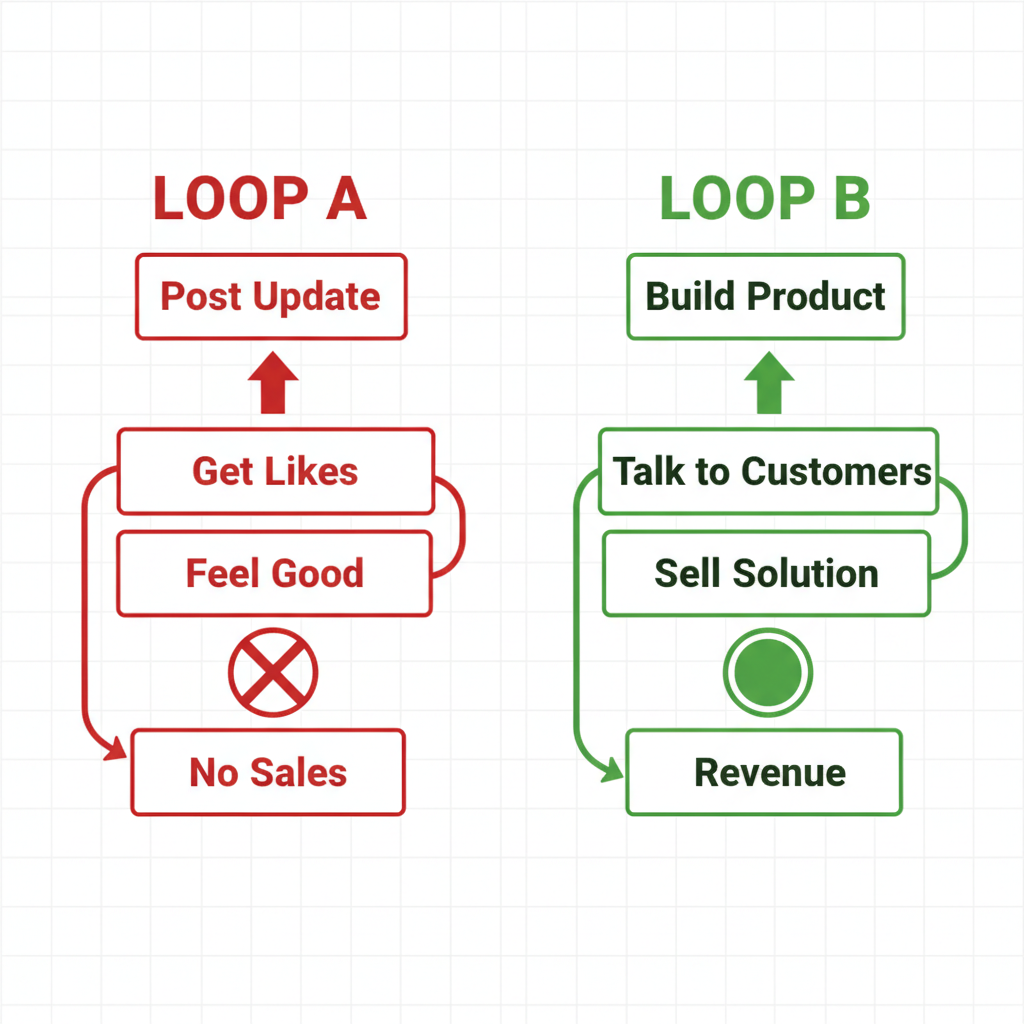
- The Dopamine Trap: Posting updates trains the brain to optimize for likes and comments instead of customer feedback and revenue.
- Misleading Validation: Likes from other founders do not equal product-market fit; only paying customers validate a product.
- Competitive Disadvantage: Sharing roadmaps and revenue metrics provides competitors with a free blueprint of what works.
- Time Cost: The build in public framework creates a "time vampire," consuming hours that could be spent fixing bugs or closing sales.
- Market Blindness: Confusing a social media audience with a target market leads to building the wrong features.
Understanding the Build in Public Framework
The conventional build in public framework encourages transparency: sharing revenue stats, code updates, and daily struggles. Proponents argue this builds trust and community. However, this approach often creates an echo chamber where creators perform for an audience that cannot pay the bills. Instead of reaching potential users, founders often end up impressing peers who are equally lost.
True success requires distinguishing between attention and traction. When a founder focuses on crafting the perfect thread or Instagram carousel, they are often procrastinating on the harder work of product development and direct sales. This phenomenon, often called "productivity porn," masks the lack of tangible business progress.
The Alternative: Build in Focus, Sell in Public
Rather than broadcasting every internal process, successful entrepreneurs often adopt a "Build in Focus" methodology. This revised framework prioritizes the customer over the audience.
1. Build in Private
Keep the development process, technical stack, and internal struggles offline. This allows for "ruthless silence" and deep work without the pressure to create content about the process. Real progress is rarely linear or screenshot-worthy.
2. Sell in Public
Shift the public presence from documenting the journey to marketing the solution. Content should focus entirely on the customer's problems and the product's value proposition, not the founder's daily routine.
3. Share Results, Not Process
Customers do not need to know how the software is built; they only care that it works. Reserve public announcements for completed features, case studies, and proven results that demonstrate value.
Step-by-Step: Implementing the Strategy
Step 1: Identify the True Customer
Stop seeking validation from other founders on social media. Define exactly who the buyer is—whether it is HR professionals, developers, or marketers—and locate where they congregate online.
Step 2: Relocate Community Engagement
Move away from general startup discussions and enter niche communities relevant to the product. If building HR software, engage in HR forums; if creating developer tools, contribute to technical repositories.
Step 3: Audit Time Expenditure
Calculate the time spent creating social content versus building the product. If documenting takes 90 minutes per post, redirect that time toward talking to 12 potential customers or fixing critical bugs.
Expert Tips for the Build in Public Framework
- Ignore the "Expert" Founder: Be wary of unsolicited advice in comments. 99% of it is noise from people who do not understand the specific business context.
- Avoid the Screenshot Syndrome: Posting Stripe dashboards or analytics graphs is the business equivalent of a gym selfie. It feeds the ego but does not serve the customer.
- Validate with Revenue: The only truth is a transaction. Until money changes hands, likes and retweets are merely vanity metrics.
- Results Over Process: No one needs to know how the sausage is made, only that it tastes good. Focus marketing on the outcome.
Common Mistakes to Avoid
- Mistaking Audience for Market: Believing that a viral post equates to product-market fit. A social audience is rarely the buying market.
- Premature Announcements: Succumbing to the "Pressure Paradox" by rushing features or faking momentum just to have something to post.
- Feeding Competitors: inadvertently revealing customer acquisition costs and marketing strategies to rivals who are watching.
How AdLibrary Supports Market Research
Instead of building in public to guess what the market wants, use AdLibrary to see what is actually working. By analyzing active ad campaigns from competitors, founders can discover validated hooks, angles, and emotional triggers that are already generating revenue.
AdLibrary allows users to search across platforms like Facebook, TikTok, and YouTube to identify how successful companies speak to their customers. This provides real market intelligence without the risk of exposing internal strategies or wasting time on social media performance.
Key Takeaways
- The build in public framework can be a distraction that prioritizes social clout over business fundamentals.
- Real validation comes from paying customers, not supportive comments from other founders.
- Time spent documenting is energy not spent building; optimizing for efficiency is crucial.
- Shift the strategy to "Build in Private, Sell in Public" to protect competitive advantages and focus on revenue.
Related Tools
Frequently Asked Questions
What is the build in public framework?
The build in public framework is a strategy where founders transparently share their startup journey, including metrics, code, and struggles, on social media. While intended to build trust and community, it often distracts from core business activities and attracts an audience of non-customers.
Does the build in public framework actually work?
For many early-stage founders, it does not work effectively. It tends to generate vanity metrics (likes and retweets) rather than revenue. It creates a false sense of progress, or "dopamine trap," where social engagement is mistaken for product-market fit.
What is the alternative to the build in public framework?
The superior alternative is to "Build in Private, Sell in Public." This approach involves focusing deeply on product development without external pressure, while directing all public-facing communication toward marketing the solution to actual customers rather than documenting the founder's life.
How much time does building in public take?
Creating high-quality updates can take over 90 minutes per post, totaling 6+ hours a month. This is time that could be better spent talking to potential customers, fixing bugs, or implementing key features that directly impact the bottom line.
Why is the build in public framework risky for startups?
It exposes sensitive data like roadmaps and revenue metrics to competitors. Additionally, it subjects founders to the "Advice Avalanche," where they receive conflicting feedback from people who lack context, leading to confusion and poor decision-making.
Key Terms
- Dopamine Trap
- The psychological cycle where founders optimize for social media likes and engagement rather than seeking meaningful customer feedback and revenue.
- Screenshot Syndrome
- The habit of posting images of revenue dashboards or analytics to signal success, serving as a vanity metric rather than providing value to customers.
- Build in Focus
- A strategy emphasizing deep work and privacy during development, sharing only results and marketing messages that directly address customer needs.