
Creative Strategist Job Overview: Roles, Skills, Salary, and Research Workflow
A creative strategist functions as the critical link between data analysis and creative execution in marketing. This role requires a unique balance of analytical insight and creative vision to develop multi-platform advertising campaigns.

Sections
Behind every effective marketing campaign is a professional who connects consumer insights to scalable creative concepts.
The creative strategist is responsible for developing comprehensive marketing strategies that align business goals with compelling ad content.

The Role of a Creative Strategist in Digital Advertising
Creative strategists operate in fast-paced environments, often working across various digital marketing channels.
They facilitate clear communication between analytical teams focused on performance and creative teams focused on production.
Core Creative Strategy Duties
- Strategy Development and Testing: Creating new marketing strategies based on a deep understanding of the brand and its target audience, followed by extensive testing for efficacy.
- Project Management: Juggling multiple campaigns, deadlines, and budgets, requiring strong organizational and basic financial literacy skills.
- Client and Team Communication: Clearly coordinating concepts with internal teams, leadership, and external clients to define campaign goals and requirements.
- Campaign Brief Creation: Writing detailed instructions for copywriters, graphic designers, and video editors to ensure alignment with the overall ad concept.
- Performance Monitoring: Tracking campaign results after launch and using analytical thinking to determine success factors and necessary adjustments.
Conducting Modern Ad Intelligence and Research
Market research is a foundational responsibility for ongoing strategic success.
A strategist must continuously monitor market trends to develop campaigns that outperform competitors and secure a strong market position.
Monitoring the Digital Landscape
Creative strategists must be experts in the rapidly changing digital advertising ecosystem.
Platforms like Facebook, Instagram, TikTok, Twitter/X, and YouTube constantly update algorithms and expand their advertising formats, necessitating continuous knowledge updates.
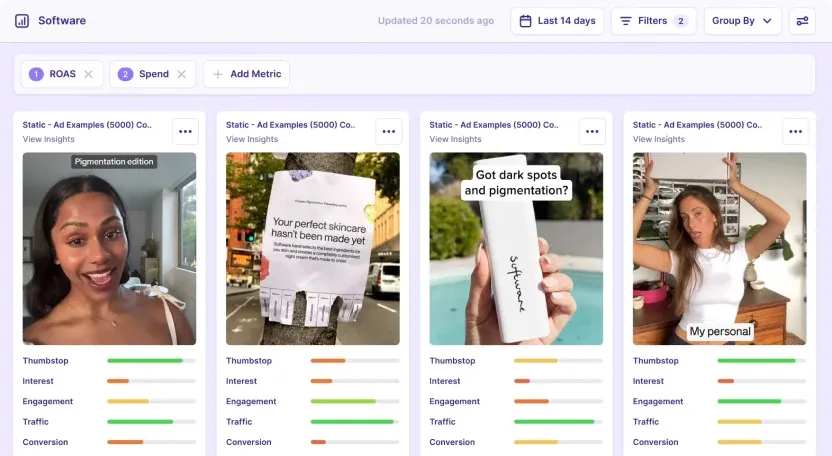
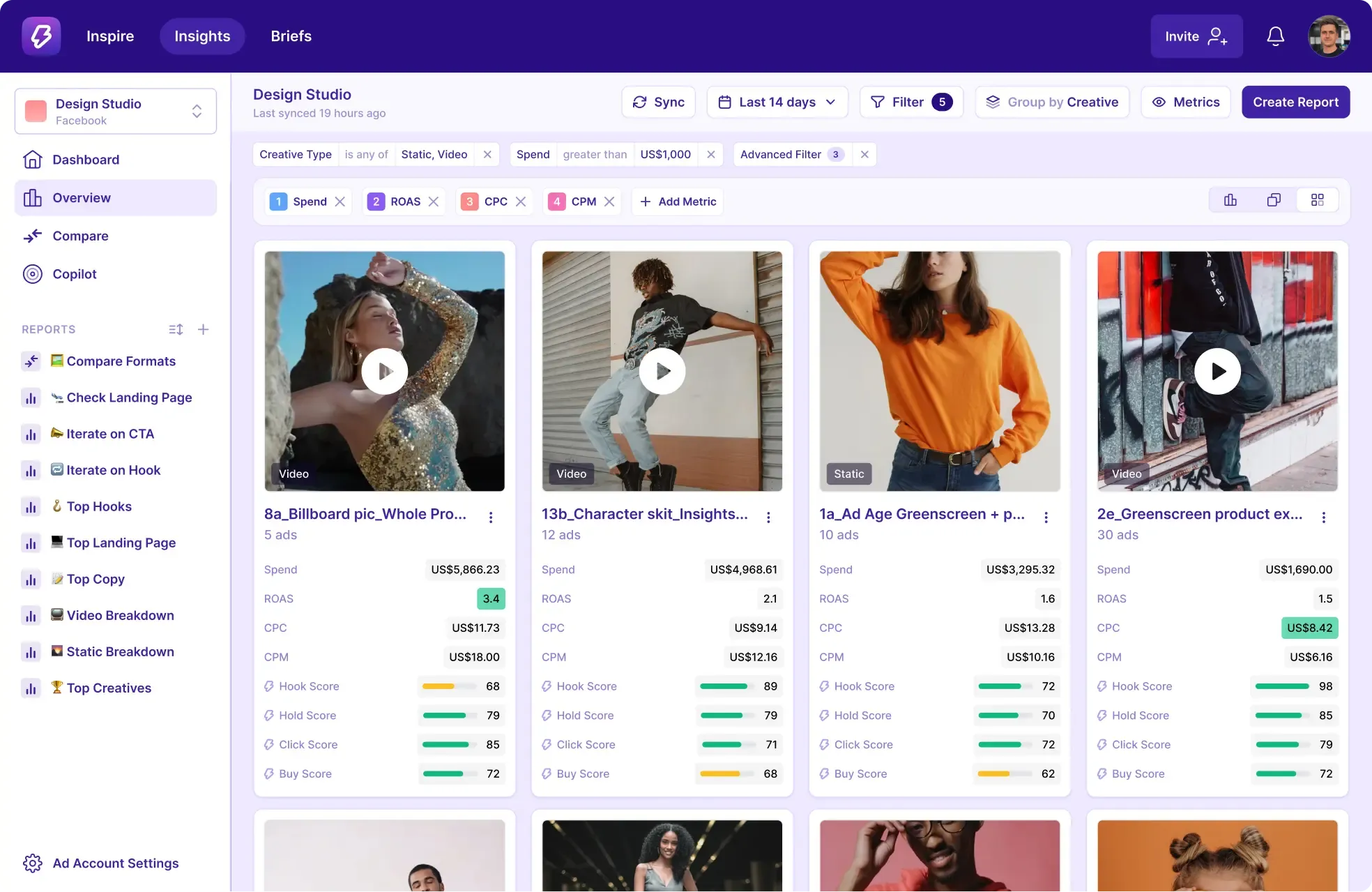
Ad intelligence tools allow strategists to filter and analyze competitor creatives by platform, country, media type, and date, streamlining research organization.
.webp) ad intelligence dashboard view."
data-placeholder="ad-intelligence-dashboard.webp"
loading="lazy"
/>
ad intelligence dashboard view."
data-placeholder="ad-intelligence-dashboard.webp"
loading="lazy"
/>
Creative Analysis: Translating Research into Messaging Hooks
A key aspect of the role involves utilizing analytical skills to gauge consumer behavior patterns and reactions.
This insight is often gathered through digital A/B testing or structured research projects like focus groups.
Key Elements for Creative Strategists to Analyze
Successful strategy relies on understanding specific ad elements across various formats.
- Ad Format Effectiveness: Determining which media types—such as short-form video, static images, or carousels—drive the highest engagement for a specific audience.
- Messaging Angles: Identifying competitor value propositions and hooks to inform the development of differentiated campaign copy.
- Audience Reaction: Analyzing how different demographic segments respond to variations in creative design and messaging.
- Competitive Benchmarks: Using ad intelligence data to set realistic performance targets for new creative launches.
Practical Workflow for Campaign Hypothesis Building
Translating initial research into actionable marketing initiatives requires a structured approach.
Following a deliberate process ensures that creative teams are equipped with the information needed to execute on strategic goals.
- Step 1: Conduct Comprehensive Ad Research: Use ad library resources to identify successful competitor creatives, filtering by platform and target country to establish relevant market trends.
- Step 2: Define the Campaign Hypothesis: Based on research and audience understanding, formulate a specific, testable statement about which creative angle or format will resonate most strongly with the target consumer.
- Step 3: Write Detailed Campaign Briefs: Document the hypothesis, objectives, target audience, media placement, and budget clearly for all creative production stakeholders.
- Step 4: Facilitate Multi-Channel Development: Coordinate the creative team (copywriters, designers, editors) to produce assets compatible with diverse advertising platforms and formats.
- Step 5: Launch and Initial Tracking: Deploy the campaign and immediately monitor key performance indicators, preparing for necessary real-time adjustments.
Preparing for the Creative Strategist Career Path
While often demanding both creative and analytical mastery, the job outlook for creative strategists remains positive, driven by the shift towards online marketing.
The necessary qualifications usually combine formal education with practical experience in the advertising field.
Educational Background and Entry Points
Most creative strategists hold a bachelor’s degree in related fields such as marketing, advertising, communications, media production, or business.
Appropriate work experience can sometimes compensate for a lack of a traditional degree, though a foundational education helps secure lower-level marketing roles.
Common starting positions that build relevant experience include account coordinator, copywriter, or social media specialist.
Essential Skills for Strategy
Success in this role relies on a versatile and adaptable skill set that balances left-brain and right-brain capabilities.
- Creative Thinking: The ability to think outside the box and develop novel concepts that capture audience attention.
- Analytical Skills: Proficiency in marketing analysis, including interpreting data to understand consumer behavior and campaign efficacy.
- Communication Proficiency: Strong verbal and written skills are crucial for managing client expectations, leading creative teams, and documenting detailed briefs.
- Social Media Fluency: Deep familiarity with major social media platforms and the trends governing user engagement in those spaces.
Creative Strategist Compensation Overview
Salaries for this role vary based on geographic location, industry, and the level of professional experience.
The median reported salary for a creative strategist is $95,146 per year, with ranges typically falling between $72,095 and $116,522 USD.
.webp)
Five Common Mistakes in Creative Strategy
Even experienced professionals face challenges when developing and executing new advertising strategies.
Awareness of common failure patterns can help minimize risks and improve iteration cycles.
- Mistake: Focusing research solely on internal ideas. Corrective Principle: Effective strategy requires continuous, objective monitoring of competitor activity and broad market trends.
- Mistake: Failing to define a multi-channel plan. Corrective Principle: Marketing initiatives must be developed with familiarity for various digital platforms and their unique ad format requirements.
- Mistake: Launching creatives without robust testing. Corrective Principle: Extensive digital A/B testing should be integrated into the workflow to gauge consumer reactions before full market deployment.
- Mistake: Creating vague or incomplete campaign briefs. Corrective Principle: Detailed briefs are mandatory to set up copywriters, designers, and editors for success and align creative output with strategic goals.
- Mistake: Neglecting to track long-term progress. Corrective Principle: Analytical skills must be used post-launch to monitor performance, learn why campaigns succeeded or failed, and inform future strategic adjustments.
Frequently Asked Questions (FAQ)
Do certifications enhance career prospects?
Specific certifications are generally not strict requirements for this role, which prioritizes skills and experience.
However, obtaining relevant certifications through universities or online platforms can help candidates differentiate themselves in a competitive field.
Is a master’s degree necessary to succeed?
A master's degree is typically not required for success as a creative strategist.
Most employers place greater emphasis on demonstrating practical marketing experience and a proven, versatile skill set than on advanced education.
What is the current job outlook for creative strategists?
The job outlook is highly positive, driven by the global expansion of digital and online marketing campaigns.
Professionals proficient in managing and understanding the complexities of digital advertising are consistently in high demand across industries.