
How to Increase Paid Ads Performance in 2026: The Rule of Doubling
Learning how to increase paid ads performance requires moving beyond random A/B testing to a structured hierarchy of decisions. By applying the "Rule of Doubling," marketers can systematically optimize every layer of their account—from product selection to creative visuals—to achieve consistent growth. This guide breaks down the exact testing order needed to scale seven and eight-figure brands.

Sections
Quick Summary
To increase paid ads performance, you must follow a specific "Rule of Doubling" testing hierarchy. Instead of random tests, prioritize optimizations in this order: Product, Offer, Desire, Features, Personas, Positioning, Angles, and finally, Visuals. This structure ensures you solve the biggest bottlenecks first.
Key Insights from This Guide
- The Rule of Doubling framework focuses on sequential testing to multiply results.
- Hero Products should always take priority over "shelf-warmers" in testing budgets.
- A Cold-Friendly Offer is essential to combat rising CPMs and lower purchasing power.
- Aligning with Market Desire (current trends/seasonality) acts as a performance multiplier.
- Creative iteration should only happen after the core message and angle are validated.
Understanding the Testing Hierarchy
The secret to learning how to increase paid ads performance lies in the order of operations. Think of your ad account like a pyramid. At the top is the Product, followed by the Offer, then the Desire (market vibe). Below that are Features, Personas, Positioning, Angles, and finally, Visuals.
If your product isn't a winner or your offer isn't compelling, no amount of creative testing (Visuals) will fix the problem. This hierarchy forces you to address the highest-impact variables first.
The Rule of Doubling Framework
This methodology is designed to help brands double their performance repeatedly. By systematically maximizing one layer of the hierarchy before moving to the next, you build a solid foundation for scaling. For example, once your "Hero Product" is maxed out, you then focus on crafting three distinct "Cold-Friendly Offers" to unlock new scale.
Step-by-Step: How to Increase Paid Ads Performance
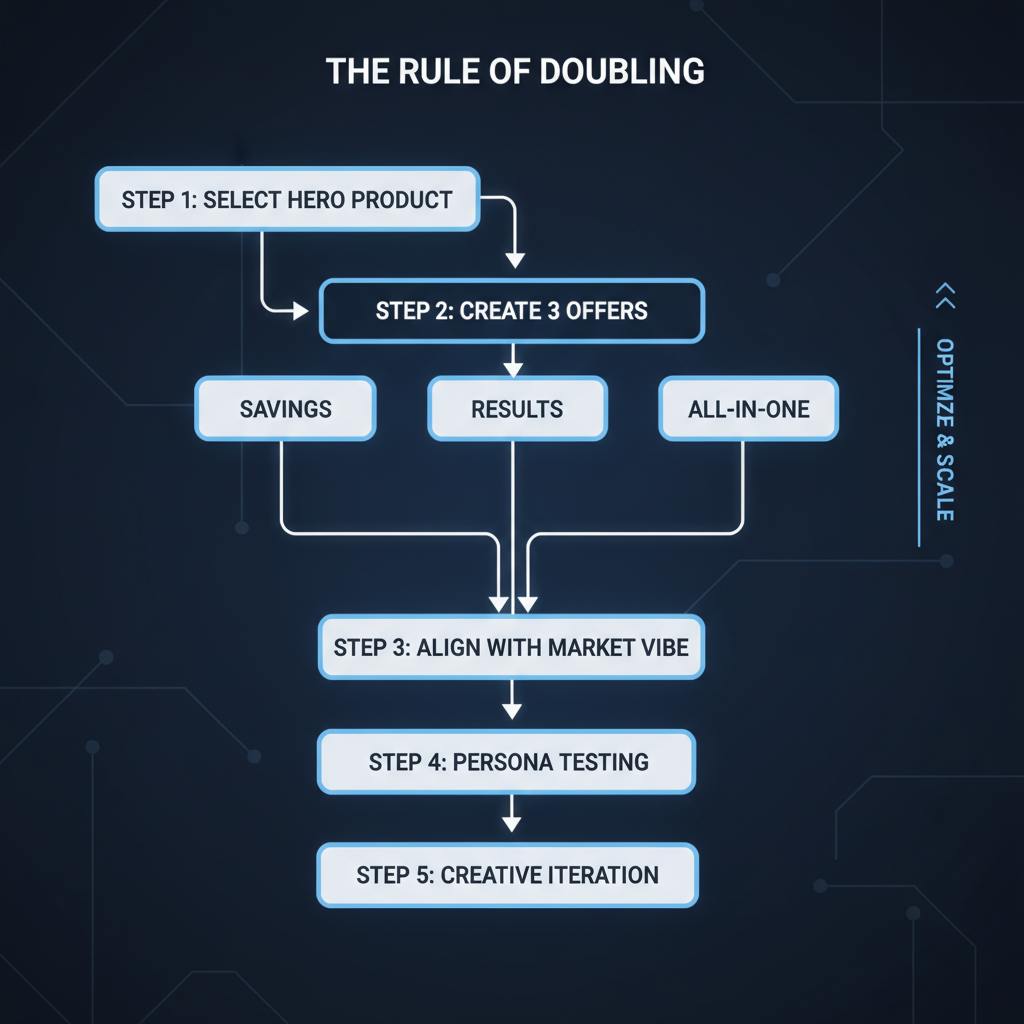
Step 1: Validate Your Hero Product
Start by identifying your "Hero Product" versus your "Ladenhüter" (shelf-warmers). Use CRM data to find which product has the best CM3 (Contribution Margin 3) and acts as the best "Door Opener" for new customers. Focus 80% of your budget here. Do not try to force low-performing products to work until the Hero Product is fully maximized.
Step 2: Craft a Cold-Friendly Offer
With rising ad costs, a standard offer often fails. You need a "Cold-Friendly Offer" genetically engineered for impulse buys. Develop three variations:
- Maximum Savings: High perceived value through bundling.
- Maximum Results: Complementary products that speed up the outcome.
- All-in-One Solution: A comprehensive package that prevents "fear of missing out."
Step 3: Align with Market Desire
Even a great offer can fail if it clashes with the current market vibe. Analyze the "Market Desire"—is the current wave about Gifting (Christmas), Shape (Summer), or Status? If the economy is down, focus on value and savings. If consumer confidence is high, focus on status. Adjust your narrative to ride the wave rather than swimming against it.
Step 4: Diversify Personas and Angles
To scale further, you must speak to different avatars. If you sell a health product, test angles for "Authority" (doctors), "Fitness" (athletes), and "Wellness" (general health). This allows ad platforms to find new pockets of users, diversifying your acquisition channels.
Step 5: Iterate Visuals at Scale
Once the script and angle are proven, unleash the creative volume. Take one winning script and produce it in 15 variations: different creators, AI voiceovers, static images, slideshows, and founder videos. This is where the "Creative System" kicks in to sustain performance.
Expert Tips for Success
- Analyze CM3: Always base product decisions on profitability (Contribution Margin 3), not just revenue.
- Post-Purchase Surveys: Ask customers what they want next. Don't rely on founder intuition for new product launches.
- Diversify Creative Formats: Don't rely on just one video type. Mix UGC, high-production, and static image ads using the same winning angle.
- Weekly Review: dedicate time every week to assess where the next "doubling" opportunity lies—is it the Offer, the Angle, or the Creative?
Common Mistakes to Avoid
- Death by Testing: Testing too many small variables (like button color) before fixing the Offer or Product alignment.
- Founder Bias: Launching products or offers because you like them, rather than based on statistical data from customer surveys.
- Ignoring Seasonality: Running a "Summer Body" angle in December. Always match the ad narrative to the current cultural conversation.
How AdLibrary Supports This Strategy
AdLibrary.com is essential for executing this framework. You can research how competitors are structuring their Cold-Friendly Offers and identify the trending Market Desires in your niche. Use the platform to find winning Angles and Visuals from top brands, allowing you to build your testing roadmap based on proven data rather than guesswork.
Key Takeaways
- Follow the hierarchy: Product > Offer > Desire > Creative.
- Focus budget on Hero Products and proven "Door Openers."
- Create specific offers for cold traffic to overcome skepticism.
- Use how to increase paid ads performance frameworks to systematically eliminate bottlenecks.
Frequently Asked Questions
What is the most important factor to increase paid ads performance?
The Product and Offer are the most critical factors. No amount of creative optimization can fix a product nobody wants or an offer that isn't competitive. Focus on validating your "Hero Product" and creating a "Cold-Friendly Offer" before worrying about ad creatives.
How do you increase paid ads performance using the Rule of Doubling?
The Rule of Doubling involves systematically optimizing one layer of your ad account at a time—starting with the Product, then Offer, Desire, Persona, and Angle. By maximizing each layer before moving down, you create a compounding effect that can double your overall results.
Why is a Cold-Friendly Offer important for performance?
A Cold-Friendly Offer is designed to convert complete strangers (cold traffic) immediately. With rising CPMs and skepticism, standard pricing often fails. These offers usually feature bundles, high perceived value, or risk-reversal guarantees to trigger an impulse purchase.
What are the best strategies to scale ad creative testing?
Once you have a winning script or angle, use a "Creative System" to produce variations. Take one winning concept and remake it with different creators, AI voiceovers, static designs, and formats. This allows you to scale volume without reinventing the wheel every time.
How can I improve my paid ads performance during economic downturns?
Align your "Market Desire" with the current economic vibe. If customers are price-sensitive, shift your messaging to emphasize value, savings, and long-term utility. Avoid status-heavy or luxury messaging if the general market sentiment is focused on conservation and practicality.
Key Terms
- Rule of Doubling
- A systematic testing framework that prioritizes optimizing Product, Offer, and Strategy layers sequentially to achieve compound growth.
- Cold-Friendly Offer
- A specific offer structure designed to convert cold audiences immediately through high perceived value or bundles.
- Hero Product
- The flagship product with the highest demand and validated market fit, which should receive the majority of ad spend.
- CM3 (Contribution Margin 3)
- A profitability metric that calculates revenue minus COGS, fulfillment, and ad spend, indicating true ad profit.