
Strategic Facebook Advertising: A Guide to Performance and Optimization
An analysis of Facebook's advertising ecosystem, detailing campaign structures, targeting capabilities, and creative testing workflows for 2026.
Sections
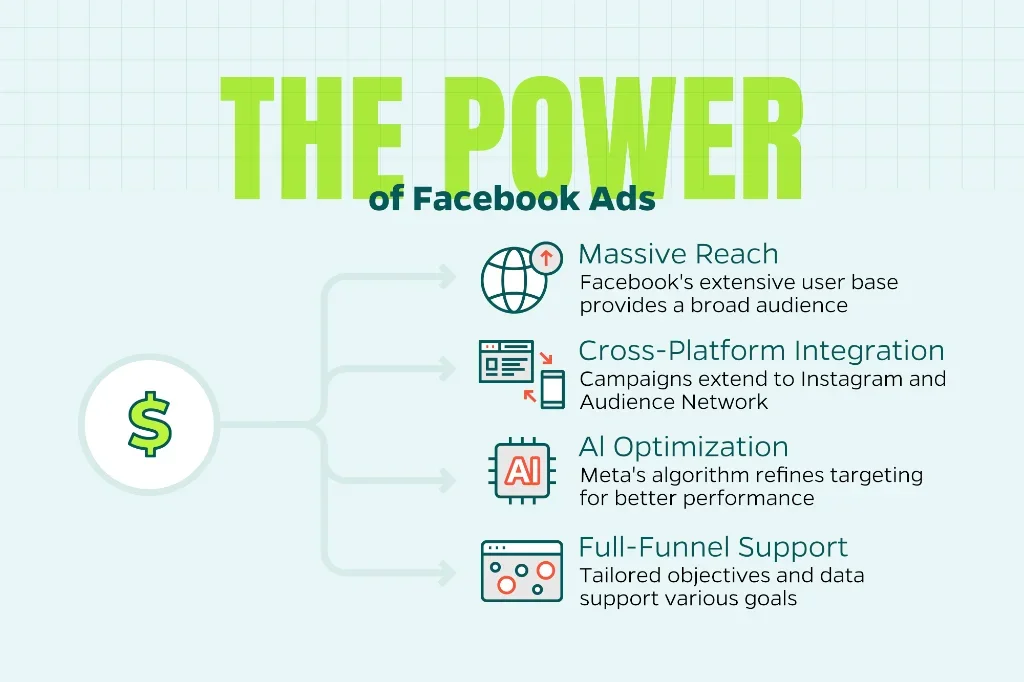
Facebook continues to dominate the digital advertising landscape, offering marketers access to over 3 billion monthly active users and a sophisticated artificial intelligence engine. For media buyers and strategists, success on the platform requires a deep understanding of campaign architecture, audience signal management, and creative diversification.
Understanding Campaign Objectives and Structure
The foundation of any successful Facebook strategy lies in selecting the correct campaign objective. The platform's algorithm optimizes delivery based on the desired outcome, whether that is brand awareness, website traffic, lead generation, or direct sales conversions. Misaligning the technical objective with the actual business goal often leads to inefficient spend.
Effective account management relies on a strict three-tier hierarchy:
- Campaign Level: Defines the primary objective and overarching goal.
- Ad Set Level: Controls audience targeting, placement selection, budget allocation, and bidding strategies.
- Ad Level: Contains the visual creative, copy, and destination links.
Maintaining a clean structure allows for accurate data analysis. Grouping distinct audiences into separate ad sets enables the algorithm to test variables without cross-contamination, while separating different creative concepts at the ad level facilitates clearer performance reporting.
Audience Targeting Mechanics
Facebook's targeting capabilities allow advertisers to leverage both first-party data and platform behavioral signals. Understanding the different audience types is critical for full-funnel marketing.
Core and Interest-Based Audiences
This method utilizes demographic data, interests, and behaviors native to the platform. It is useful for prospecting new customers but requires precise refinement to ensure relevance. Advertisers can filter by age, location, and specific user interests to narrow the potential reach.
Custom and Lookalike Audiences
Custom Audiences represent high-intent segments, such as website visitors, past purchasers, or engaged social followers. These are typically used for retargeting campaigns. Lookalike Audiences leverage this data to find new users who share similar characteristics with an existing high-value seed list, offering a scalable method for acquisition.
Advantage+ and AI-Driven Targeting
Modern campaigns increasingly rely on Advantage+ targeting, which utilizes machine learning to automate audience expansion. By allowing the algorithm to broaden targeting parameters based on conversion data, advertisers can often achieve lower costs per acquisition compared to strict manual constraints.
Creative Strategy and Formats
Creative assets act as the primary lever for performance in a privacy-first advertising environment. Diversifying ad formats helps combat ad fatigue and caters to different user preferences across the ecosystem.
- Single Image and Video: Standard formats effective for direct messaging and feed placements. Mobile-first design is essential.
- Carousel Ads: Allow for storytelling or multi-product showcases, encouraging higher interaction rates through swiping.
- Collection Ads: Provide an immersive, instant-loading shopping experience directly within the app, ideal for e-commerce catalogs.
- Reels and Stories: Vertical, full-screen formats that demand authentic, native-style content to capture attention quickly.
Budgeting and Bidding Strategies
Budget allocation dictates how the algorithm explores and stabilizes performance. Daily budgets offer consistency for ongoing campaigns, while lifetime budgets are better suited for scheduled promotions with fixed end dates.
Bidding strategies also vary by goal. Lowest Cost (automatic) bidding aims to maximize volume within budget, while Cost Caps and Bid Caps provide manual control over efficiency, preventing spend on expensive auctions. ROAS (Return on Ad Spend) goals allow the system to bid dynamically to maintain a specific profitability target.
Practical Workflow: Setting Up for Success
Follow this standardized workflow to launch campaigns with a high probability of success.
- Step 1: Define the Primary Objective. Select the campaign goal that mathematically aligns with your KPI (e.g., Sales for e-commerce, Leads for B2B).
- Step 2: Configure Technical Tracking. Ensure the Meta Pixel is installed and standard events (Purchase, Lead, AddToCart) are firing correctly.
- Step 3: Establish Campaign Architecture. Create a campaign shell and define ad sets based on distinct audience segments or geographic targets.
- Step 4: Upload Creative Variations. Prepare 3-5 creative assets per ad set to give the algorithm sufficient options for testing.
- Step 5: Set Bids and Budgets. input a daily budget that allows for at least 50 conversion events per week to exit the learning phase.
- Step 6: Launch and Monitor. Publish the campaign and allow 72 hours of data accumulation before making optimization decisions.
Common Mistakes in Facebook Advertising
Avoiding these frequent errors can preserve budget and accelerate optimization.
- Resetting the Learning Phase: Making significant edits to budget or creative too frequently forces the algorithm to restart its learning process, inefficiently spending budget. Correction: Batch edits and allow 3-7 days between significant changes.
- Objective Mismatch: Choosing "Traffic" when the goal is "Sales" results in cheap clicks that do not convert. Correction: Always optimize for the actual business outcome desired.
- Ignoring Creative Fatigue: Running the same ads to the same audience indefinitely causes frequency to rise and performance to plummet. Correction: Rotate creative assets when frequency metrics exceed 3-4.
- Aggressive Budget Scaling: Doubling budgets overnight often breaks optimization logic. Correction: Scale budgets incrementally by 20-50% every few days.
- Neglecting Mobile Optimization: deploying desktop-centric creative on a platform where 90% of traffic is mobile. Correction: Ensure all text is legible and visual focal points are clear on small screens.
Frequently Asked Questions
Why is the Meta Pixel necessary for advertising?
The Meta Pixel provides the feedback loop required for algorithm optimization. It tracks user actions on your website, allowing Facebook to attribute conversions to specific ads and find more users likely to take similar actions.
How much budget is needed to start?
A recommended starting point is typically $10-50 per day per ad set. This level of spend usually generates enough data for the system to learn which audiences and creatives perform best without excessive waste.
What is the difference between a boosted post and an ad campaign?
Boosted posts are simplistic promotions designed for engagement. Ads Manager campaigns offer full control over objectives, targeting layers, bidding strategies, and creative testing, making them superior for performance marketing.