
How to Scale Paid Ads: A Strategic Guide for Growth
Scaling paid advertising is a critical challenge that moves beyond simply increasing spend. It requires a systematic approach to creative development, audience targeting, and funnel optimization to maintain profitability while expanding reach.
Sections
Scaling paid advertising is a critical challenge that moves beyond simply increasing spend. It requires a systematic approach to creative development, audience targeting, and funnel optimization to maintain profitability while expanding reach.
 scaling paid advertising.">
Core Principles of Effective Ad Scaling
Successful ad scaling hinges on two foundational elements: building trust and leading with proof. In crowded markets, consumer trust is low, and generic promises are ineffective. The most resonant campaigns address specific customer pain points directly and immediately.
Instead of focusing on a unique promise, which competitors can easily replicate, focus on unique proof. Customer testimonials, case studies, and real-world results are proprietary assets that build credibility and differentiate a brand. The more specific and relatable the proof, the more powerful it becomes.
How Ad Platforms Interpret Creative Signals
Modern ad platforms like Meta and Google use sophisticated AI that analyzes creative content to inform targeting. The words in an ad's copy, the text within a video, and the visual elements all serve as signals to the algorithm about the intended audience.
This means that detailed, niche-specific creative can be more effective than broad targeting settings alone. If an ad for a dental recruiting service repeatedly mentions dentists and their specific professional challenges, the platform's AI will learn to prioritize showing that ad to users who fit the dentist profile.
 ad creative to identify targeting signals." loading="lazy">
A Framework for Creative Testing and Iteration
A disciplined approach to creative development is essential for scaling. The 70-20-10 model provides a useful framework for allocating resources to maximize campaign performance and longevity.
Under this model, 70% of resources are dedicated to iterating on proven, top-performing ad concepts. This involves creating minor variations—changing hooks, headlines, or calls-to-action—to squeeze more performance from a winner. 20% is allocated to adjacent concepts that are similar in style to the winners, while the final 10% is reserved for experimental, high-risk ideas that could become the next major breakthrough.

Designing Ad Funnels for Qualification and Conversion
The structure of an advertising funnel should be designed to match the audience's level of awareness and intent. For cold traffic, the goal is often to generate a lead with a low-friction offer, such as a free guide, checklist, or estimate.
Friction can be strategically added to a funnel to improve lead quality. For example, adding a video sales letter (VSL) or a short application form creates positive friction that filters out less motivated prospects. The key is to balance lead volume with lead quality; if leads are poor, add friction, and if volume is too low, remove it.
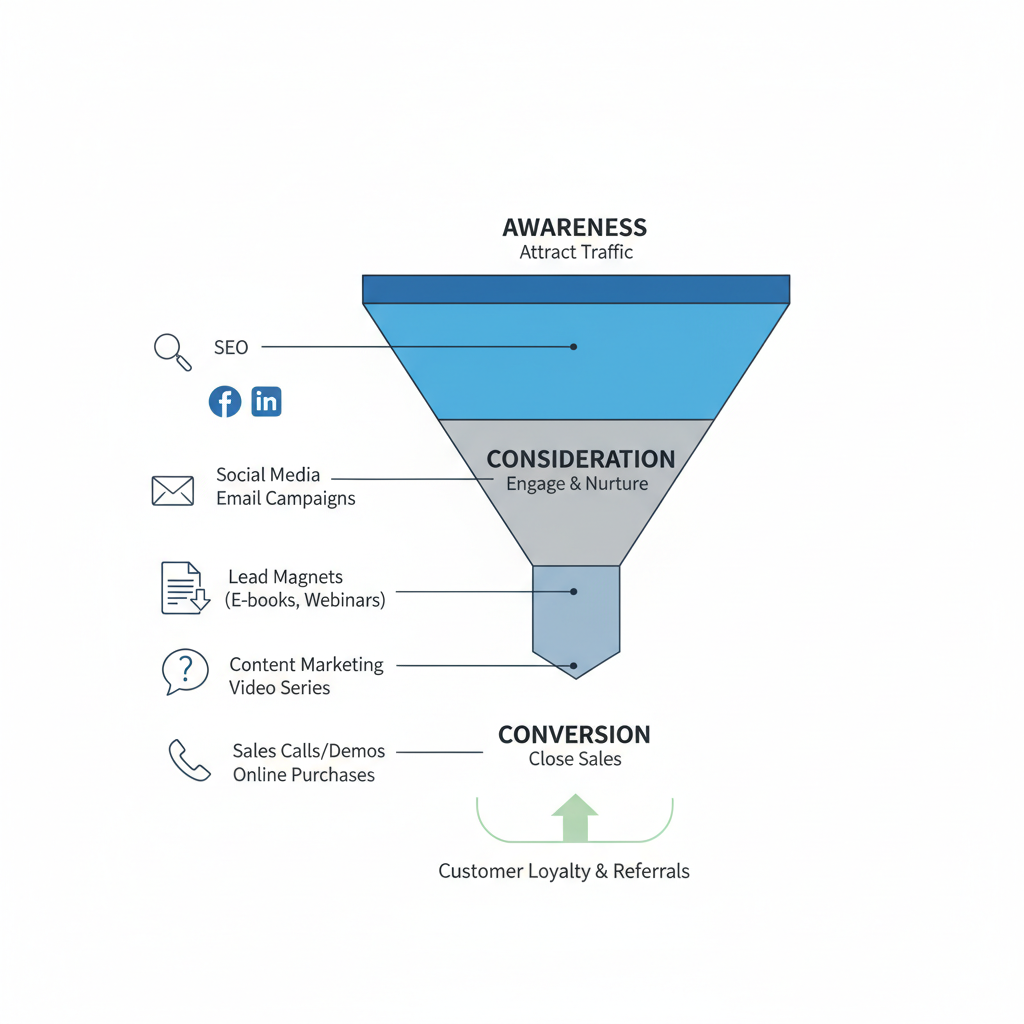 funnel, showing how users move from initial ad exposure to becoming a qualified lead." loading="lazy">
A Practical Workflow for a Scaling Campaign
Executing a scalable paid ad strategy involves a repeatable process focused on insight, creation, and optimization.
- Step 1: Identify Core Pain Points. Begin by deeply understanding the primary challenges and frustrations of the target customer. All effective ad hooks originate from a clear articulation of this pain.
- Step 2: Gather Compelling Proof. Collect and organize the most compelling customer results available. Prioritize proof that is specific, relatable to the target audience, and hard to falsify, such as video testimonials or detailed case studies.
- Step 3: Develop a High-Value Lead Magnet. Create a free resource or offer that directly addresses the identified pain points. This serves as the initial point of entry into the funnel and provides value upfront.
- Step 4: Launch Foundational Campaigns. Start with campaigns that target the highest-intent audiences. This includes retargeting all website visitors and creating lookalike audiences from existing customer lists.
- Step 5: Analyze and Iterate on Winners. Once a creative concept proves successful, dedicate the majority of production resources to creating numerous variations. Test new hooks, visuals, and copy angles based on the core winning formula.
Common Mistakes in Scaling Paid Ads
Avoiding common pitfalls is just as important as implementing best practices. Many advertisers struggle to scale because they make unforced errors in strategy and execution.
- Failure: Relying on promises instead of proof.
Principle: Let credible, specific customer results form the core of the ad creative. Your proof is your most unique marketing asset. - Failure: Neglecting retargeting.
Principle: Always run a global retargeting campaign across all relevant platforms to capture users who have already shown interest. - Failure: Abandoning winning ads too quickly.
Principle: A single winning ad can be the basis for dozens or even hundreds of variations. Systematically reskin and re-test winners until performance truly degrades. - Failure: Confusing good friction with bad friction.
Principle: Add strategic friction like applications or VSLs to qualify leads. Remove unnecessary friction like slow-loading pages or confusing forms. - Failure: Lacking a post-click qualification process.
Principle: Cold traffic requires nurturing. Implement a sales or follow-up process to filter and convert leads after they opt-in. - Failure: Mismatching the offer to the audience.
Principle: Use low-commitment offers for cold audiences. High-intent audiences, such as those from search campaigns or retargeting, can be sent to higher-commitment offers. - Failure: Believing creative production is not a core discipline.
Principle: For direct-to-consumer and many B2B businesses, scaling is a direct function of creative output. Treat creative development as a central operational process.
Analyzing competitor campaigns and successful ads from adjacent industries can provide critical insights into effective hooks, messaging angles, and proof-based formats. Using an ad intelligence platform like AdLibrary.com allows marketers to research creative strategies at scale, helping to generate hypotheses for testing and accelerate the learning process.