
High-Converting Facebook Ads: The Hyperdopamine Strategy Guide
Creating **high-converting Facebook ads** requires shifting focus from technical algorithms to human psychology. This guide explores the "Hyperdopamine" strategy, designed to flood a prospect's brain with dopamine using pattern interrupts, deep curiosity, and specific benefits to maximize engagement and ROI.

Sections
Effective advertising on social platforms is no longer about outsmarting the algorithm or complex account structures. To create high-converting Facebook ads today, advertisers must master the psychology of attention. By treating ads as content that delivers news, entertainment, or value, brands can bypass "banner blindness" and compete with the organic content flooding users' feeds.
Quick Summary
High-converting Facebook ads rely on a "Hyperdopamine" framework that combines three critical elements: a pattern-interrupting visual, burning intrigue in the headline, and a specific benefit for the user. Success comes from mimicking popular news and gossip formats to sell the click rather than the product immediately.
Key Insights from This Guide
- Algorithm Agnosticism: Media buying tactics fade, but psychological principles are evergreen.
- The Dopamine Factor: Ads must compete with high-dopamine content like viral videos and news.
- News & Gossip Model: The most viewed pages on Facebook (e.g., LADbible, TMZ) use specific headline formulas that advertisers can model.
- Curiosity Gaps: The most powerful driver of clicks is the gap between what a user knows and what they want to know.
- Readability Rules: Top-performing copy is written at a 5th-grade reading level.
Understanding High-Converting Facebook Ads
Most advertisers fail because they create content that looks like an advertisement. Users have conditioned themselves to ignore polished, corporate imagery. To generate high-converting Facebook ads, the creative must blend seamlessly with the native content of the platform.
The core philosophy is to "sell the click," not the product. The ad's sole purpose is to stop the scroll and generate enough curiosity to get the user off the platform and into the funnel. This approach targets the entire market pyramid—not just the 3% ready to buy, but the 97% who are unaware or in information-gathering mode.
The Hyperdopamine Ad Framework
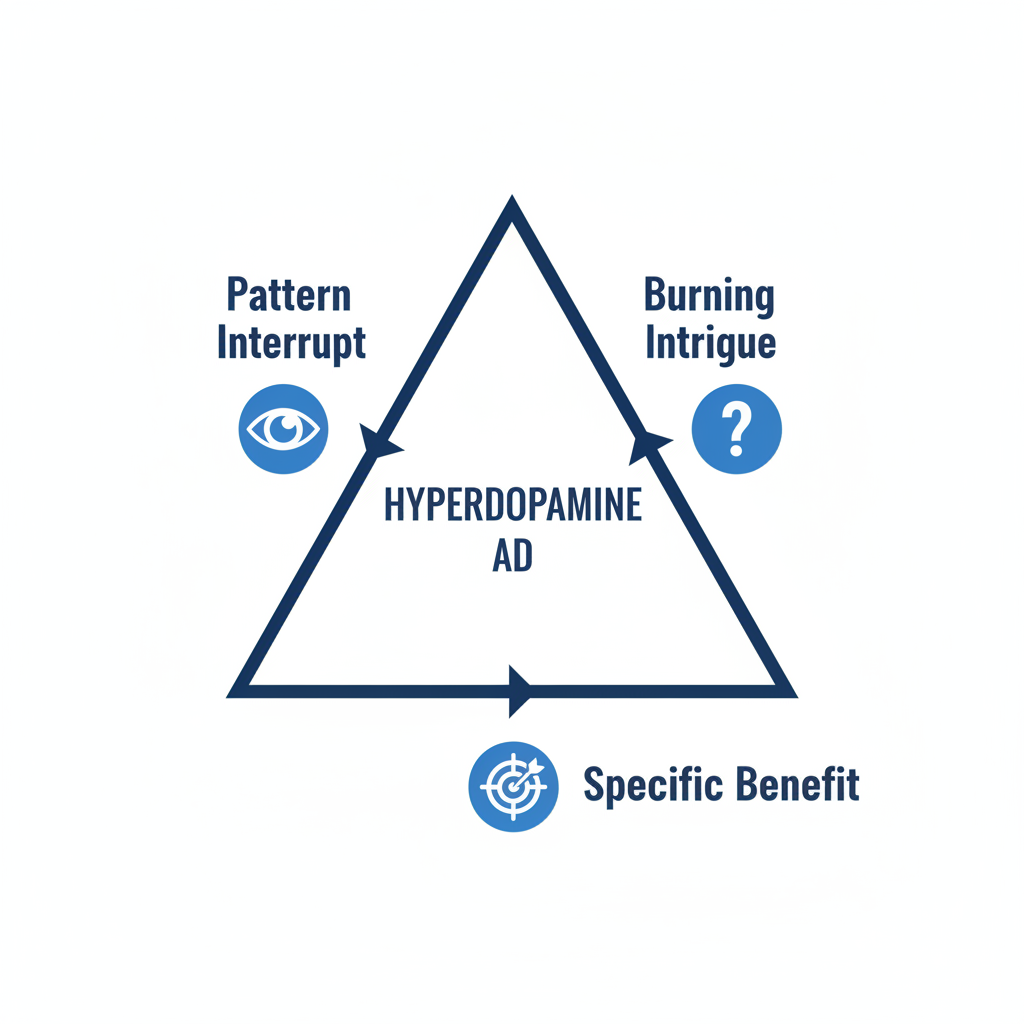
A "Hyperdopamine Ad" is engineered to release dopamine in the viewer's brain, much like a breaking news story or a viral meme. It sits at the intersection of "Clickbait" (intrigue) and "Targeted Benefit" (value). It consists of three pillars:
- Pattern Interrupt: A visual that breaks the standard scroll rhythm (e.g., raw photos, weird angles, high contrast).
- Burning Intrigue: A headline or concept that creates an irresistible need to know more.
- Specific Benefit: A clear promise of what the user gets (e.g., "Lose 12kg," not "Get fit").
Step-by-Step: Creating High-Converting Facebook Ads
Step 1: Select a Disruptive Creative Style
Choose a visual format that looks native to the platform. Proven styles include:
- Raw Native: Unpolished photos taken on a smartphone.
- Breaking News: Banners and overlays that mimic news alerts.
- Native Highlight: A photo with a red circle or arrow drawn on it to direct focus.
- SMS/Notification: A screenshot of a text message or bank notification relevant to the offer.
Step 2: Engineer the Headline
Write headlines that model popular news sites. Use curiosity gaps and specific numbers. For example, instead of "Tips for Homeowners," use "Homeowners Go Wild After Spotting This New Loan Hack." Ideally, combine a primary image with a secondary inset image to hold attention longer.
Step 3: Write "Butter" Body Copy
The copy should be a "slippery slope" that is effortless to read. Use short sentences, simple words (1-2 syllables), and frequent line breaks. Aim for a reading grade level of 3 to 5 (use tools like Hemingway App to check). Avoid corporate language; write exactly how people speak.
Step 4: The Non-Threatening Call to Action
Use a "soft" CTA. Data suggests that "Learn More" consistently outperforms aggressive CTAs like "Sign Up" or "Buy Now." The goal is to lower the psychological barrier to clicking.
Expert Tips for High-Converting Facebook Ads
- Specifics Sell: Replace vague claims with hard numbers. Specificity adds depth and believability (e.g., "480 leads" vs. "lots of leads").
- Visual Contrast: Use "ugly" or raw images. They often outperform polished studio photography because they feel authentic and stop the eye.
- Positive Hooks: While fear works, positive benefits typically outperform negative angles by an 8:2 ratio.
- Character Limits: Keep copy under 2,200 characters for cross-platform compatibility, but don't fear long copy if it remains interesting.
Common Mistakes to Avoid
- Looking Like an Ad: If it looks like a banner ad, users will scroll past it. Make it look like user-generated content or news.
- Blind Clickbait: Using curiosity without relevance (e.g., "You won't believe this") attracts low-quality traffic. Always pair intrigue with a relevant benefit.
- Complex Language: Using industry jargon or complex sentence structures increases cognitive load and reduces consumption.
- Obsessing Over Targeting: Focusing on audience settings instead of creative. The creative is the targeting in modern advertising.
How AdLibrary Supports High-Converting Facebook Ads
AdLibrary.com provides the essential research tools needed to execute the Hyperdopamine strategy. Users can search for ads with high engagement to identify which "news hooks" and visual styles are currently working in their niche.
By analyzing the "Saved Ads" of competitors, marketers can deconstruct the pattern interrupts and headlines that are driving traffic right now, ensuring their own creative strategy is built on proven data rather than guesswork.
Key Takeaways
- Obsess Over People: Psychology beats algorithms every time.
- Steal Like an Artist: Model headlines from gossip magazines and news sites.
- Pattern Interrupts: Use raw, native, or weird images to stop the scroll.
- Simplicity Wins: Write simply, clearly, and specifically to keep users reading.
Related Tools
Frequently Asked Questions
What makes high-converting Facebook ads different from regular ads?
High-converting Facebook ads focus on psychology rather than technical settings. They utilize 'Hyperdopamine' elements—intrigue, pattern interrupts, and news-style formatting—to mimic organic viral content, ensuring they stop the user's scroll and encourage engagement.
How long should the copy be for high-converting Facebook ads?
While Facebook allows up to 2,200 characters, there is no perfect length. Long copy often outperforms short copy if it is interesting and readable. The key is to edit aggressively, ensuring every sentence pulls the reader to the next, regardless of total length.
What is the best image style for high-converting Facebook ads?
"Raw Native" images often perform best. These are photos taken on a smartphone that look unpolished and authentic. Other effective styles include "Breaking News" overlays and images with hand-drawn red circles or arrows to direct focus.
Why should I write ads at a 5th-grade reading level?
Lowering the reading grade level reduces cognitive strain, making the ad easier to consume. Best-selling books and viral content are typically written at a 5th-grade level or below. If the copy is effortless to read, more people will consume the message and convert.
Should I use 'Learn More' or 'Shop Now' for high-converting Facebook ads?
Tests consistently show that "Learn More" is the highest-converting call to action. It is non-threatening and implies value or information rather than a financial commitment, which lowers the friction for the initial click.
Key Terms
- Hyperdopamine Ad
- An ad creative designed to release dopamine by combining a pattern interrupt, high curiosity, and a specific benefit.
- Pattern Interrupt
- A visual or headline element that breaks the expected flow of a social media feed, causing the user to stop scrolling.
- Slippery Slope
- A copywriting technique where each sentence compels the reader to read the next, creating momentum down to the call to action.
- Blind Clickbait
- Creating curiosity without a relevant benefit or context, which attracts low-quality clicks and is discouraged.