
VSL Ads: The Complete Guide to E-commerce Video Sales Letters
VSL ads (Video Sales Letters) are high-converting long-form video advertisements designed to scale e-commerce brands beyond the limits of standard creative. By combining direct response copywriting psychology with structured storytelling, VSL ads educate cold audiences, shift their beliefs through a logical mechanism, and create high-intent buyers ready to purchase immediately. This guide covers the complete VSL ad framework, from hook to close, with actionable steps for e-commerce brands.

Sections
Quick Summary: What Are VSL Ads?
VSL ads are long-form video advertisements, typically 5 to 10 minutes, that function as a complete sales presentation within a single video ad. To master VSL ads, you must move beyond simple product showcases. A successful video sales letter follows a strict four-part structure: Hook, Lead, Body, and Close. Unlike short UGC ads that sell benefits, VSLs sell a new understanding of the problem (the mechanism), proving why previous solutions failed and why your offer is the only logical answer.
Key Insights from This VSL Ads Guide
- Scale Potential: VSL ads allow for significantly higher daily ad spend compared to standard UGC. Learn more in our guide to scaling Facebook ads.
- The Mechanism: The core persuasion tool that explains the root cause of a problem and drives conversion rates.
- Four Phases: Every video sales letter must have a Hook, Lead, Body, and Close.
- Audience Targeting: VSLs target "Problem Aware" audiences within the marketing funnel, not just impulsive buyers.
- Format Types: Doctor/Expert, Customer Story, and Documentary styles each serve different creative strategies.
Understanding VSL Ads for E-commerce
A Video Sales Letter (VSL) in modern e-commerce is typically a 5 to 10-minute video designed to act as a complete sales person. While standard image ads or 60-second videos target the "Most Aware" audience (those ready to buy), VSL ads target the much larger "Problem Aware" or "Solution Aware" segments of the conversion funnel.
These viewers know they have a pain point but have not found the right solution. The VSL ad takes them on a journey from realizing the true cause of their problem to understanding why your specific product is the unique solution. This process generates higher Average Order Value (AOV) and lifetime value because the customer is fully educated and "bought in" before they even reach checkout.
If you are new to e-commerce advertising, start with our complete guide to starting an e-commerce business before diving into VSL ads.
The 4-Phase VSL Ad Framework
Successful high-scale VSL ads follow a proven psychological sequence. This framework draws from decades of classic direct response copywriting principles adapted for video.
Phase 1: The Hook (0:00–00:10)
The hook is everything. The goal is relevant attention, not just viral views. You must call out the specific audience (e.g., "If you are a mother of three...") and open a loop or state a bold claim. If you attract the wrong people here, the video will fail later. For proven hook structures, see our ad copy formulas guide.
Phase 2: The Lead (0:10–1:00)
Here, you dimensionalize the problem. You acknowledge where the viewer is (their current pain) and widen the gap between their reality and their desired outcome. The goal is to build tension and promise a revelation, ensuring they commit to watching the rest of the video. This mirrors the "Agitate" step in the PAS framework.
Phase 3: The Body and Mechanism (1:00–8:00)
This is the core educational section of your VSL ad. You introduce the Problem Mechanism (the real root cause of their issue) and the Solution Mechanism (the antidote). By explaining why past solutions failed (they did not address the mechanism), you build trust. You then introduce your product as the delivery vehicle for that solution, backed by proof and social proof.
Strong ad copy in this section is critical. Every sentence must earn the next second of watch time.
Phase 4: The Close (8:00–End)
Once belief is established, you trigger action. This involves presenting the offer, stacking value with bonuses, removing risk with strong guarantees, and applying urgency">urgency or scarcity">scarcity to force a "buy now" decision. Your call to action must be clear and direct.
The "Mechanism" Explained: Why VSL Ads Convert
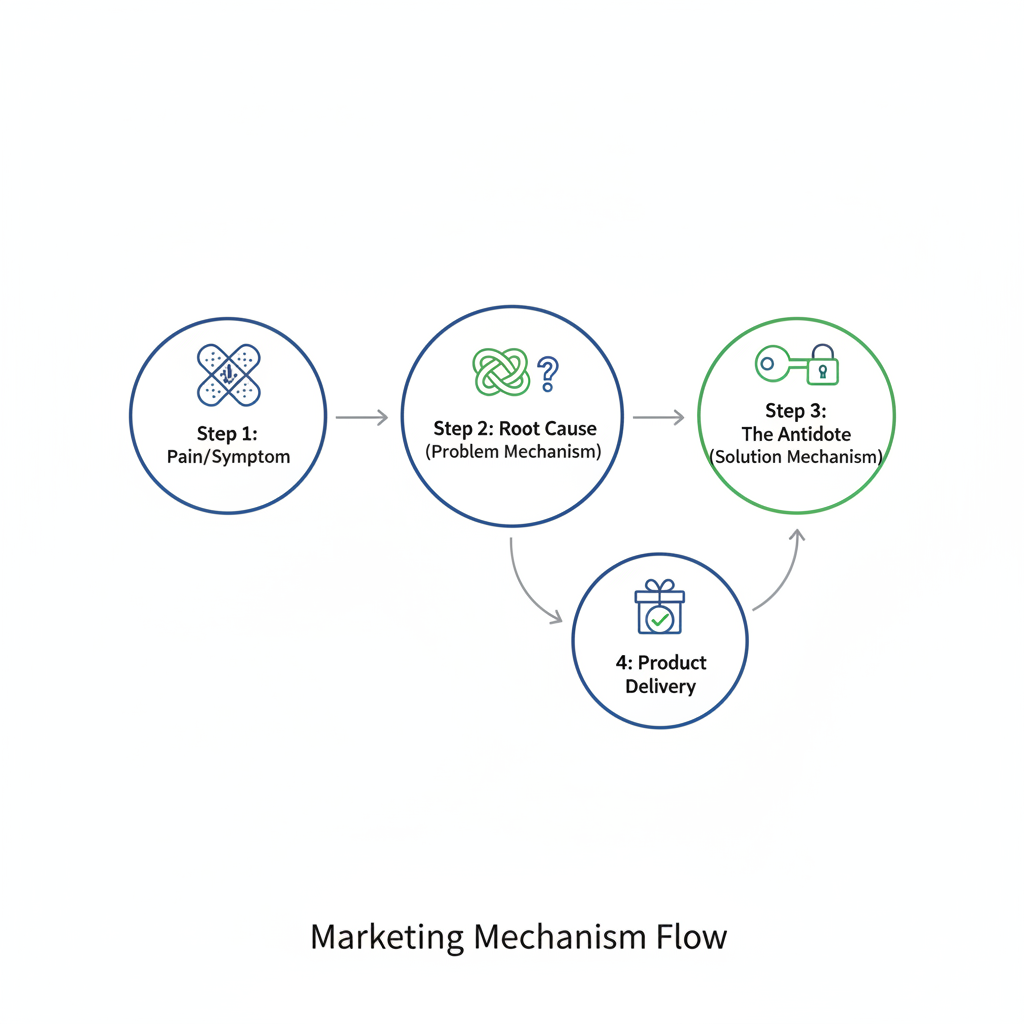
The secret sauce of a VSL ad is the "Mechanism." It shifts the conversation from "trust me, this works" to "now I understand why this works." This is the single most important element that separates high-converting VSL ads from generic video content.
- Problem Mechanism (Root Cause): Explains why the user still has the problem despite trying other solutions. (e.g., "Your acne is not caused by dirt; it is caused by overactive oil production at night.")
- Solution Mechanism (Antidote): The logical counter to the root cause. (e.g., "To stop acne, you must regulate night-time oil production.")
- The Product: The tool that delivers the solution mechanism. This is where your value proposition becomes undeniable.
Three High-Performing VSL Ad Archetypes
Depending on your market and product, choose one of these narrative styles for your video sales letter:
- The Doctor/Expert: High authority. Ideal for health, supplements, or complex problems where skepticism is high. The expert explains the mechanism clinically. This archetype pairs well with testimonial">testimonial proof points.
- The Customer Story: High relatability. A peer shares their journey from struggle to success. Best for emotional purchases or when the market is tired of "experts." Similar to effective UGC ad strategies.
- The Documentary/Editorial: High engagement. Framed as an investigative report or neutral discovery. Excellent for cold traffic that is resistant to obvious ads. See our viral ad creation framework for more on attention-hijacking techniques.
Step-by-Step: Creating Your VSL Ad
Step 1: Deep Research and Mining
Before scripting, research competitor reviews, forums, and Reddit. Look for specific language regarding pains and failed solutions. Identify the common frustrations to build your Problem Mechanism. Use competitor ad research to find existing VSL ads in your niche and reverse-engineer their mechanisms.
Step 2: Define the Mechanisms
Clearly articulate the Root Cause (why they struggle) and the Unique Solution (how you fix it). Ensure these are logically connected. If the solution does not directly address the stated root cause, conversion will suffer.
Step 3: Scripting and AI Assistance
Use AI tools to draft scripts by feeding them your research data. Ask for specific structures: Hook, Lead, Body (Mechanism), and Close. Ensure the tone matches your chosen archetype (Expert vs. Peer). For more on AI-assisted ad creation, read our guide on building an AI marketing assistant.
Step 4: Editing for Retention
Edit the video to maintain a "social media" feel initially, transitioning into a sales argument. Visuals should support the logic. Use simple diagrams to explain the mechanism so it "clicks" instantly for the viewer. For more on video ad production, see our video ad creation guide.
VSL Ads vs UGC Ads: When to Use Each
One of the most common questions in e-commerce advertising is whether to invest in VSL ads or UGC ads. The answer depends on your funnel stage and scale goals:
- UGC ads work best for warm audiences and quick creative testing. They are fast to produce and feel authentic. See our UGC ads guide for best practices.
- VSL ads unlock scale by converting cold audiences who need education before buying. They require more investment but deliver higher ROAS at scale.
- The winning strategy is to use both: UGC for prospecting and retargeting, VSLs for scaling into cold traffic.
Testing and Scaling Your VSL Ads
Creating the VSL is only half the battle. You need a structured testing strategy to find the winning version:
- Test Hooks Daily: A VSL ad's performance often hinges entirely on the first 10 seconds. Keep the body the same but swap the hook frequently.
- Focus on the "Click" Moment: The moment the viewer understands the mechanism is when they buy. Make this visual and simple.
- Congruency is Key: The VSL ad, the landing page, and the checkout flow must all tell the same story and use the same mechanism language.
- Value Stack the Offer: In the close, make the product feel essentially free compared to the value and bonuses provided.
- Apply the Rule of Doubling: Once you find a winning VSL, scale methodically using the Rule of Doubling framework.
Once your VSL ad is performing, follow our guide to scaling e-commerce revenue to build on that momentum.
Common VSL Ad Mistakes to Avoid
- Mistake 1: Boring Leads. If you do not build tension or open a "knowledge gap" in the first minute, viewers will not stay for the sales pitch. Study the AIDA framework to nail your attention sequence.
- Mistake 2: Missing the Mechanism. Selling only benefits (e.g., "get clear skin") without explaining how (the mechanism) makes you look like every other failed product. This is where most VSL ads fail.
- Mistake 3: Weak Calls to Action. After 10 minutes of education, you must be directive. Tell them exactly what to click and what happens next. Review CTA best practices to strengthen your close.
- Mistake 4: No Creative Testing. Running a single version of your VSL without A/B testing hooks, leads, and closes leaves performance on the table.
- Mistake 5: Ignoring Ad Fatigue. Even great VSL ads decay over time. Monitor CTR and refresh your hooks regularly to maintain performance.
How AdLibrary Supports VSL Ad Research
Creating a winning VSL starts with analyzing what works in your niche. AdLibrary allows you to search for long-form video ads across platforms like Facebook, YouTube, and TikTok. You can filter by video duration to specifically find VSL ads (often 3+ minutes) and analyze their hooks, mechanisms, and offer structures.
By saving successful VSLs to your personal library, you can reverse-engineer their scripts to identify the "Problem Mechanisms" your competitors are using, helping you position your product mechanism as superior. For a deeper dive into competitor ad research, explore our analysis workflows.
Combine this with our ads library analysis guide to build a complete research-to-execution pipeline for your VSL ads.
Key Takeaways for VSL Ads
- VSL ads unlock scale by educating cold audiences who are not yet ready to buy impulsively.
- The "Mechanism" is the core logic that shifts belief from skepticism to certainty. It is what separates high-performing VSL ads from generic video content.
- Structure is non-negotiable: Hook, Lead, Body, Close. Follow the AIDA framework as your foundation.
- Use AI to accelerate research and scripting, but ensure the psychological flow remains human-centric.
- Pair your VSL ads with a robust e-commerce advertising strategy for maximum impact.
Frequently Asked Questions
What are VSL ads and why do they work?
VSL ads (Video Sales Letters) are long-form video advertisements, typically 5-10 minutes long, that act as a complete sales presentation. They work by educating 'problem-aware' audiences, shifting their beliefs through a logical mechanism, and building high intent before the click, allowing for higher scale than short ads.
What is the difference between a Problem Mechanism and a Solution Mechanism?
The Problem Mechanism explains the real 'root cause' of why a user struggles (e.g., 'slow metabolism due to toxins'). The Solution Mechanism is the specific method your product uses to fix that root cause (e.g., 'detoxifying ingredients to boost metabolism'). They must logically link together.
How long should a VSL ad be?
Effective e-commerce VSL ads usually range from 5 to 10 minutes. However, they can be as short as 3 minutes or as long as 20 minutes depending on the complexity of the product and the depth of education required to shift the buyer's belief.
What are the best strategies for VSL hooks?
Great hooks call out a specific audience (e.g., 'Mothers over 30') and open a curiosity loop or challenge a common belief. Strategies include 'The Neugierde Hook' (curiosity), 'The Negative Trigger' (fear of loss), or a 'Mini Pitch' that promises a specific outcome immediately.
Do I need professional production for VSL ads?
Not necessarily. While polish helps, the structure and script are far more important. Many successful VSLs use simple stock footage, b-roll, or a 'selfie-style' expert video combined with clear on-screen text and diagrams. Clarity and audio quality matter more than cinematic visuals.
Key Terms
- Problem Mechanism
- The specific, logical explanation of the root cause behind a customer's pain point, used to validate why previous solutions failed.
- Belief Shift
- The psychological process of moving a prospect from a state of skepticism or false beliefs to a new understanding that aligns with your product's solution.
- Lead
- The section of a VSL immediately following the hook (30-60 seconds) designed to dimensionalize the problem and build tension before the main content.